How many times have you stared at a blank sketchbook, a new Illustrator artboard, or an empty room plan, and just thought... nothing?
We have this dangerous myth in the creative industry that creativity is a talent you are simply born with. You either have the "gift," or you don't. And when the ideas don't magically appear, we assume something is wrong with us. We push harder, we get frustrated, we rush the process, and we expect brilliant solutions before we've even done the groundwork.
But what if I told you creativity isn't a mystical talent at all? What if it's just a reliable, repeatable mental process?
I often reference Emilio DiIorio's insights on this, and they echo exactly what Mitch Goldstein touches upon in How to Be a Design Student. Creativity is not a lightning strike; it is a structured way we generate and refine ideas. It’s a process, and like any process, it can be learned.
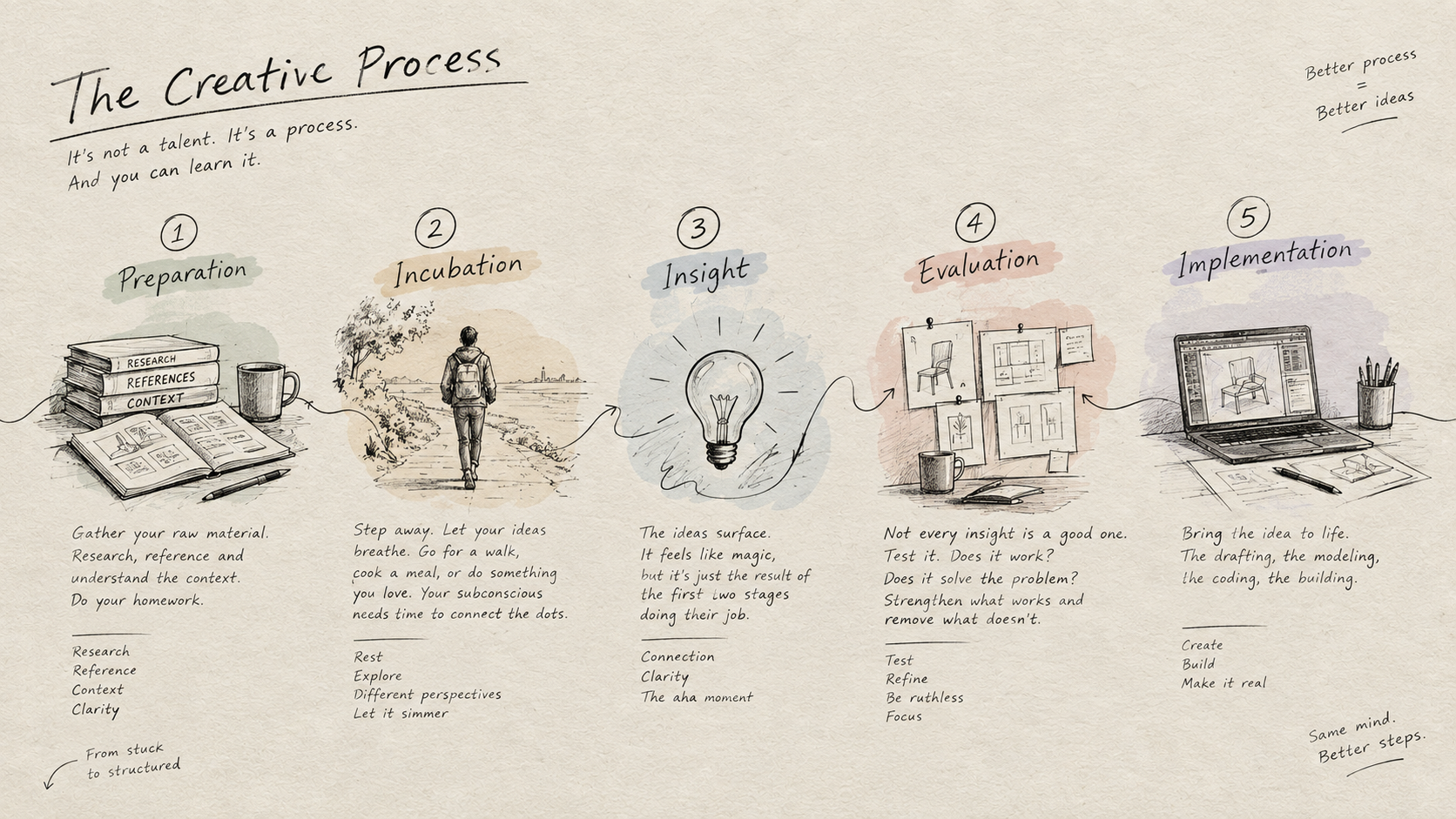
If you're feeling stuck, it's likely because you are skipping steps in the creative process. Here is the five-stage breakdown that can take your practice from random panic to reliable output.
Preparation
This is where you gather your raw material. You can't expect a brilliant design to emerge if you haven't fed your brain with research, reference, and context. As Alex Schultz notes in The Art and Science of Digital Marketing and Advertising, even in data-driven fields, true growth requires deep preparation and understanding your base before you can build outward. Do your homework.
Incubation
This is the step most young designers skip. Once you have the information, you have to step away. Let your ideas breathe. Go for a walk, cook a meal, or work on a completely different hobby. As Austin Kleon says in Steal Like an Artist, "A hobby is something that gives but doesn't take". Your subconscious needs time to connect the dots you gathered in the preparation stage.
Insight
This is the "aha" moment. It’s when those incubated ideas finally surface into your consciousness. It feels like magic, but it’s actually just the result of the first two stages doing their job.
Evaluation
Not every insight is a good one. This stage is critical. You must look at your new idea and rigorously evaluate it. Does it work? Does it solve the problem? This is where you strengthen the strong ideas and ruthlessly clear away what isn't working. It’s the analytical side of the creative coin.
Implementation
Finally, you bring the idea to life. This is the actual labor of design the drafting, the modeling, the coding, the building.
When you follow these five stages, the creative process stops being this terrifying, random roulette wheel. It becomes predictable. It becomes reliable.
Next time you are stuck, don't just push harder. Ask yourself: Which stage did I skip? You might not need to change your career; you just might need a new way of seeing the process.


