September 29, 2026
By
Prof. Suraj Vyas
How many times have you stared at a blank sketchbook, a new Illustrator artboard, or an empty room plan, and just thought... nothing?
We have this dangerous myth in the creative industry that creativity is a talent you are simply born with. You either have the "gift," or you don't. And when the ideas don't magically appear, we assume something is wrong with us. We push harder, we get frustrated, we rush the process, and we expect brilliant solutions before we've even done the groundwork.
But what if I told you creativity isn't a mystical talent at all? What if it's just a reliable, repeatable mental process?
I often reference Emilio DiIorio's insights on this, and they echo exactly what Mitch Goldstein touches upon in How to Be a Design Student. Creativity is not a lightning strike; it is a structured way we generate and refine ideas. It’s a process, and like any process, it can be learned.
If you're feeling stuck, it's likely because you are skipping steps in the creative process. Here is the five-stage breakdown that can take your practice from random panic to reliable output.
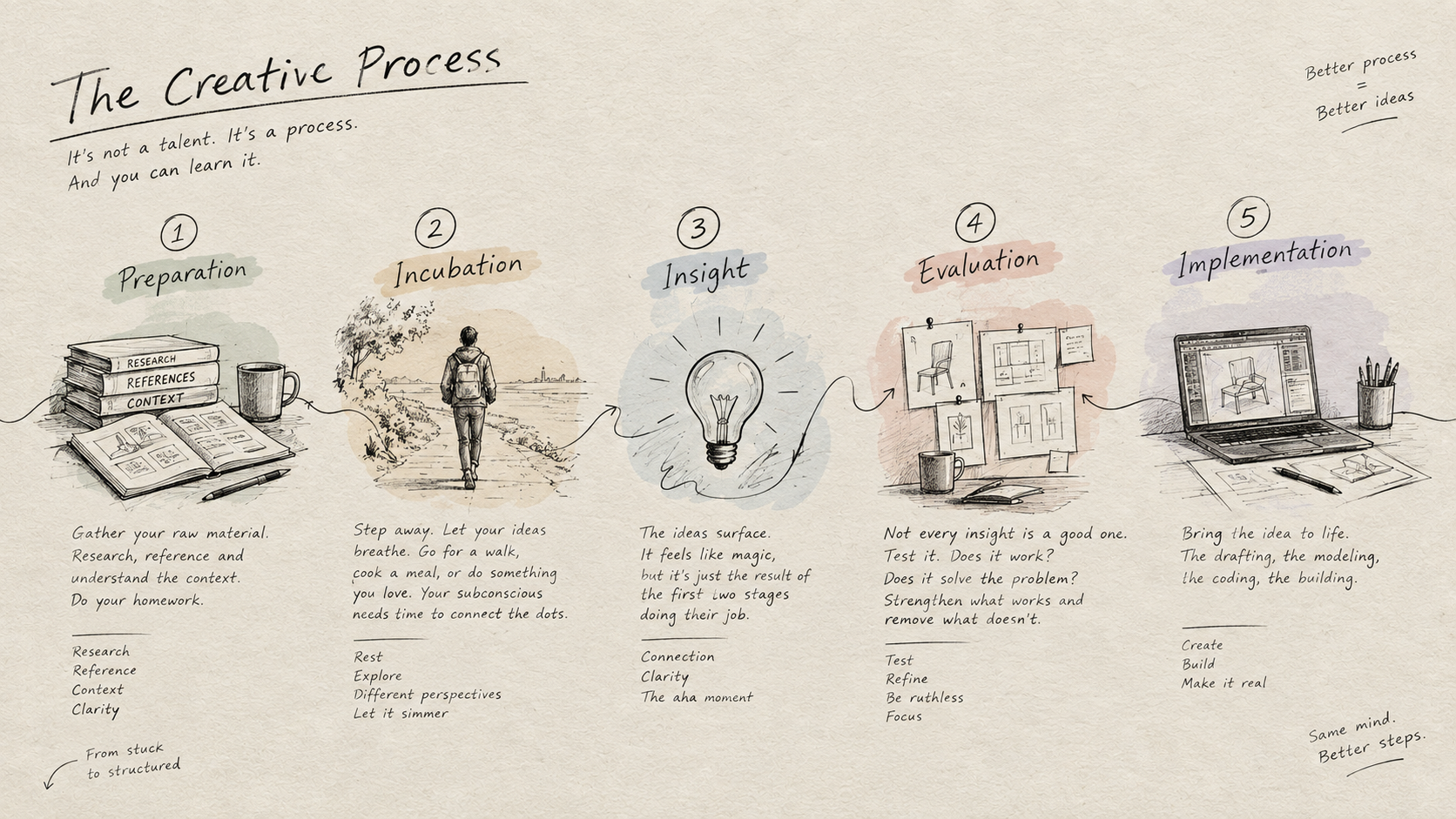
Preparation
This is where you gather your raw material. You can't expect a brilliant design to emerge if you haven't fed your brain with research, reference, and context. As Alex Schultz notes in The Art and Science of Digital Marketing and Advertising, even in data-driven fields, true growth requires deep preparation and understanding your base before you can build outward. Do your homework.
Incubation
This is the step most young designers skip. Once you have the information, you have to step away. Let your ideas breathe. Go for a walk, cook a meal, or work on a completely different hobby. As Austin Kleon says in Steal Like an Artist, "A hobby is something that gives but doesn't take". Your subconscious needs time to connect the dots you gathered in the preparation stage.
Insight
This is the "aha" moment. It’s when those incubated ideas finally surface into your consciousness. It feels like magic, but it’s actually just the result of the first two stages doing their job.
Evaluation
Not every insight is a good one. This stage is critical. You must look at your new idea and rigorously evaluate it. Does it work? Does it solve the problem? This is where you strengthen the strong ideas and ruthlessly clear away what isn't working. It’s the analytical side of the creative coin.
Implementation
Finally, you bring the idea to life. This is the actual labor of design the drafting, the modeling, the coding, the building.
When you follow these five stages, the creative process stops being this terrifying, random roulette wheel. It becomes predictable. It becomes reliable.
Next time you are stuck, don't just push harder. Ask yourself: Which stage did I skip? You might not need to change your career; you just might need a new way of seeing the process.
September 25, 2026
By
Prof. Suraj Vyas
People love to say to me, usually with a lot of confidence, "Oh, relax. It’s just interior design... it’s not brain surgery."
And you know what? I completely disagree.
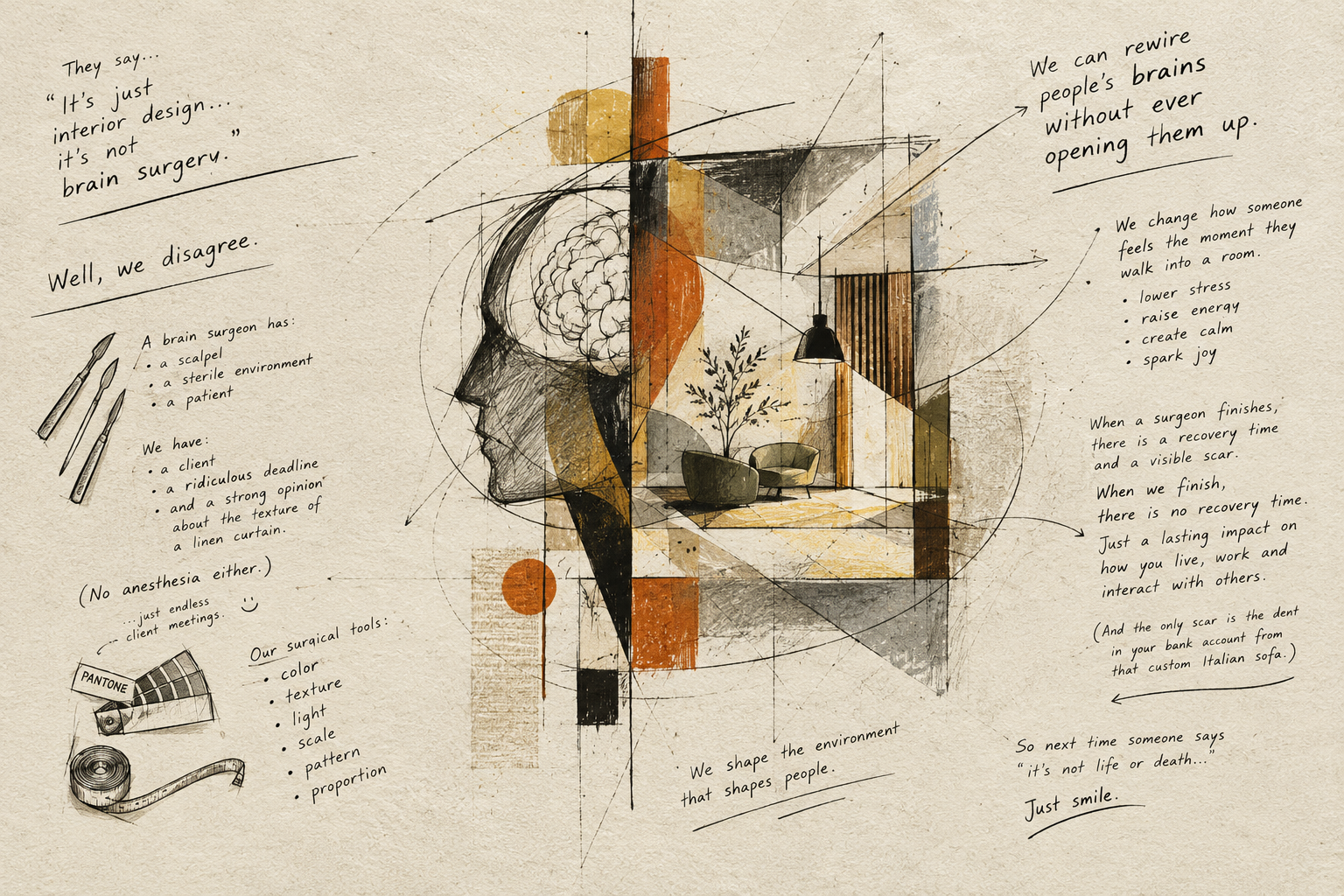
I’ll admit, when a brain surgeon walks into a room, they have a scalpel, a highly sterile environment, and a patient. As designers, we just have a client, a ridiculous deadline, and a very strong opinion about the texture of a linen curtain.
We also don’t have anesthesia although, let’s be honest, there are times during a three-hour client meeting debating 'eggshell' versus 'off-white' where a little anesthesia would be really, really nice.
But here is where our job is actually extraordinary (and maybe a little dangerous): We can rewire people’s brains without ever opening them up.
Think about it. A designer can change how someone feels the exact second they walk into a room. We can lower your stress levels or raise your energy. We can create an atmosphere of absolute calm or spark pure joy. And we do it all through our very own set of surgical tools: color, texture, light, scale, pattern, and proportion.
When a surgeon finishes their job, there is usually a mandatory recovery time and a visible scar. When we finish our job? There is no recovery time. We simply leave you with an environment that will silently shape how you live, how you work, and how you interact with others every single day.
(And the only scar is the dent in your bank account from that custom Italian sofa).
What we do as designers is powerful. We shape the environment that shapes people.
So the next time someone tells you that what you do isn't life or death, just smile. Let them think it’s just about picking out nice pillows. We know the truth. We are out here performing psychological surgery with a Pantone book and a tape measure.
What's the most "surgical" design decision you've ever had to make to save a space? Let me know in the comments below!
September 25, 2026
By
Prof. Suraj Vyas
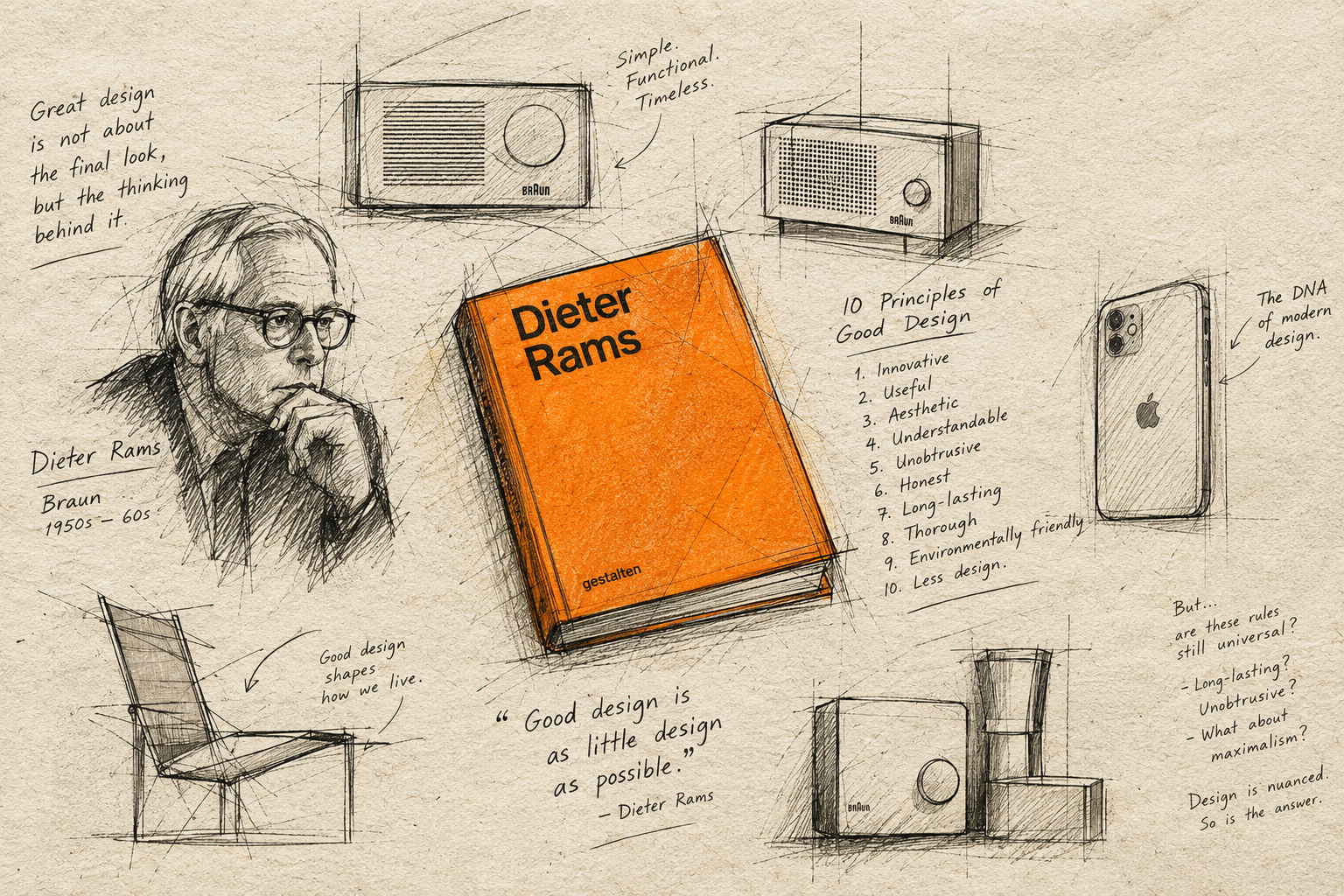
Lately, between setting up new studio modules and reviewing student portfolios, I’ve found myself revisiting some foundational design literature. While re-reading Mitch Goldstein’s How to Be a Design Student, it struck me how often we emphasize the organic process of design over the final aesthetic. This thought inevitably brought me back to the ultimate visual shorthand for "good design" that heavy, ubiquitous orange coffee table book simply titled Dieter Rams.
You’ve probably seen it. It sits casually in almost every architecture firm, design studio, or high-end minimalist space. But beyond the striking bright orange cover, what is Rams actually trying to teach us?
Austin Kleon famously wrote in Steal Like an Artist that nothing is truly original; we simply build upon the brilliant work of our predecessors. Dieter Rams is the perfect testament to this. His iconic work for Braun in the 1950s and 60s didn't just define a generation of appliances it literally laid the design and interface groundwork for the Apple iPhone sitting on your desk right now.
In the late 1970s, looking around at a world becoming increasingly cluttered with poorly made things, Rams asked himself: "Is my design good design?" His answer was a manifesto. He wrote the 10 Principles of Good Design, arguing that products must be innovative, useful, aesthetic, and understandable. They should be unobtrusive, honest, long-lasting, thorough, and environmentally friendly. And his golden rule: Good design is as little design as possible.
It’s a brilliant framework. But as I often tell my students during our open studio critiques, we must question everything even the absolute masters.
Are these rules truly universal? Take the "long-lasting" principle, for instance. Today, we recognize that designing something to be virtually indestructible can sometimes mean relying on non-degradable, harmful materials. What was once seen as durable is now sometimes viewed as an environmental liability.
Or consider the push for "unobtrusive" minimalism. Sometimes, we simply don't want quiet design. Sometimes, we are tired of relentless functional innovation and crave maximalism, cultural expression, and things that are beautifully, loudly unnecessary.
Design is likely too nuanced for strict commandments. But whether you view Rams’ principles as a sacred text or an outdated set of rules, they force us to stop and ask why we are making something. They demand intention. And sparking that critical conversation might just be the true point of that orange book after all.
What’s your take? Are you a strict minimalist, or do you believe rules are meant to be broken once you master them?
September 25, 2026
By
Prof. Suraj Vyas
We have this debate in the design department all the time.
Usually, it happens late in the afternoon, right when the studio is buzzing with energy. Someone will look at a particularly striking prototype or a beautifully functional space and ask the inevitable question:
“Is this art, or is this design?”
It’s a conversation that never really gets old. And honestly? The lines are getting blurrier by the day.
In today’s creative landscape, we hate putting things into boxes. We want to be everything all at once. Sometimes people look at my interior projects or my photography and call me an artist. I always smile and take the compliment, but deep down, I know that label doesn't entirely fit what I do.
So, where exactly do we draw the line?
Over the years, working with countless students and running my own practice, I’ve realized it boils down to two simple things: Intention and Functionality.
Let’s talk about Design first.
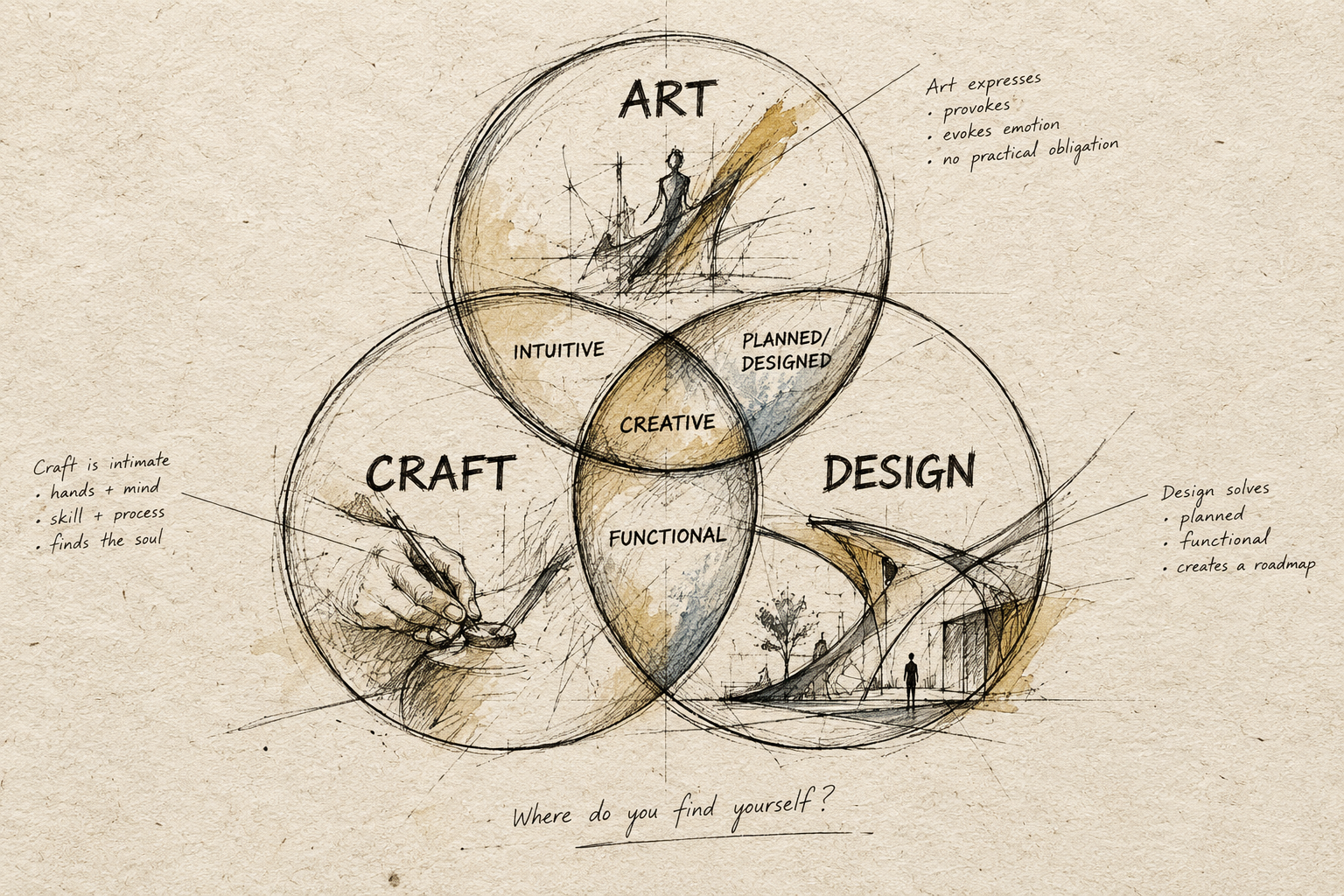
Design is calculated. It is premeditated. When we design something whether it's a chair, a branding campaign, or a spatial layout—we are creating a roadmap. The goal is to solve a specific problem. It must be functional. In our industry, we don't say a great product happened "by creative intuition." We say it happened "by design."
Then there is Craft.
Craft is deeply intimate. It’s what happens when someone’s brain connects directly to their hands. Yes, it is functional, but it’s less about a rigid master plan and more about the fluid, highly skilled act of making. A craftsperson often discovers the final soul of the object while they are shaping it.
And Art?
Art is the rebel. It can be highly planned, or it can be a sudden splash of pure intuition on a canvas. But unlike design and craft, art doesn't carry the heavy burden of having to "work" or serve a practical purpose. It exists simply to express, to provoke, or to make you feel something.
Do these three worlds overlap? Absolutely.
The most fascinating work usually happens right in those murky, overlapping spaces of a Venn diagram. The boundaries are meant to be pushed. But understanding the core distinction helps us understand our own creative identity. It gives us a compass.
It makes you stop and ask yourself: When I sit down to create, what exactly am I trying to do?
I’d love to hear your thoughts on this. Where do you find yourself on this spectrum?

April 09, 2026
By
Prof. Suraj Vyas
I wanted to write this first post personally, not just as the Head of Department, but as someone who loves design. When new students begin their journey exploring design in Bhavnagar, they often think design is about learning software, using a digital pen, or holding a Tool perfectly.
Yes, those tools are important. But if you only learn the tools, you aren't a designer. You are a technician.
A few days ago, I was thinking about the philosophy of the great architect Hassan Fathy. He said something that I believe applies to every designer whether you are creating a dress, a chair, or a mobile app. He said that if you don't have a philosophy, your work is just engineering.
Engineering is essential. It tells us how to make something structurally sound. But Design? Design tells us why we are making it in the first place.
Why are we surrounded by "cold" objects?
Look around you. Modern production is very efficient, but it is often sterile. Many things we buy feel empty. They work perfectly, but they have no soul.
At GID, my goal is to teach you how to put that soul back in.
We focus on three things that turn "engineering" into true "design":
Listen to the "Spirit of Place" (Genius Loci): We are situated in the heart of Gujarat. Studying design here means you don't have to look far for inspiration. We have a rich history of craft, colors, and textures right outside our doors. Why should we only copy global trends? Your design must belong to the soil it comes from. It must listen to our local context.
The Human Connection: We do not design for machines or statistics. We design for people. We must think about the emotional scale, not just the physical one. Does a user feel safe using your app? Does a person feel dignified wearing your garment?
Process over Outcome: Many students are in a rush to see the final product. But true design is in the rigorous process. The constant questioning, the prototyping, the thinking. It is the hard work that turns raw intuition into a professional skill.
As your HOD, I don't just want you to leave GID with a degree and job skills. I want you to leave here as a philosopher of the physical world. I want you to look beyond your Tools, or your screen, and find the radiance that moves the human heart.
Let’s create something with a soul.


