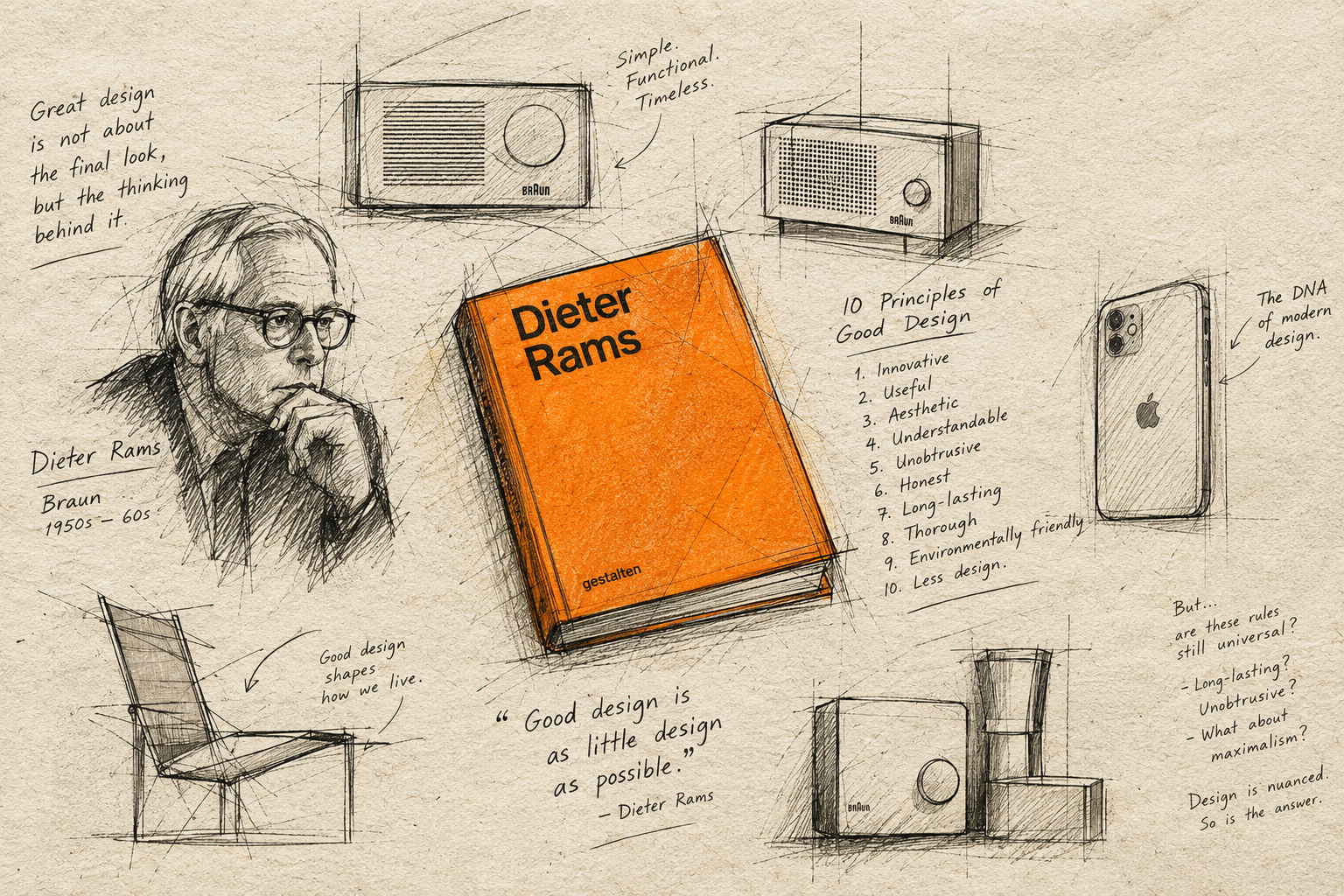
Lately, between setting up new studio modules and reviewing student portfolios, I’ve found myself revisiting some foundational design literature. While re-reading Mitch Goldstein’s How to Be a Design Student, it struck me how often we emphasize the organic process of design over the final aesthetic. This thought inevitably brought me back to the ultimate visual shorthand for "good design" that heavy, ubiquitous orange coffee table book simply titled Dieter Rams.
You’ve probably seen it. It sits casually in almost every architecture firm, design studio, or high-end minimalist space. But beyond the striking bright orange cover, what is Rams actually trying to teach us?
Austin Kleon famously wrote in Steal Like an Artist that nothing is truly original; we simply build upon the brilliant work of our predecessors. Dieter Rams is the perfect testament to this. His iconic work for Braun in the 1950s and 60s didn't just define a generation of appliances it literally laid the design and interface groundwork for the Apple iPhone sitting on your desk right now.
In the late 1970s, looking around at a world becoming increasingly cluttered with poorly made things, Rams asked himself: "Is my design good design?" His answer was a manifesto. He wrote the 10 Principles of Good Design, arguing that products must be innovative, useful, aesthetic, and understandable. They should be unobtrusive, honest, long-lasting, thorough, and environmentally friendly. And his golden rule: Good design is as little design as possible.
It’s a brilliant framework. But as I often tell my students during our open studio critiques, we must question everything even the absolute masters.
Are these rules truly universal? Take the "long-lasting" principle, for instance. Today, we recognize that designing something to be virtually indestructible can sometimes mean relying on non-degradable, harmful materials. What was once seen as durable is now sometimes viewed as an environmental liability.
Or consider the push for "unobtrusive" minimalism. Sometimes, we simply don't want quiet design. Sometimes, we are tired of relentless functional innovation and crave maximalism, cultural expression, and things that are beautifully, loudly unnecessary.
Design is likely too nuanced for strict commandments. But whether you view Rams’ principles as a sacred text or an outdated set of rules, they force us to stop and ask why we are making something. They demand intention. And sparking that critical conversation might just be the true point of that orange book after all.
What’s your take? Are you a strict minimalist, or do you believe rules are meant to be broken once you master them?


